BUILT TO CHARGE. SUPPORTED TO PERFORM.

Your EV charger is an investment in your everyday drive. Cosmic Charge provides ongoing technical support, troubleshooting, system monitoring, and guidance to help keep your charging system performing at its best.

SUPPORT DOCUMENTATION

Find answers to common questions and technical guides

Updated 10/12/26

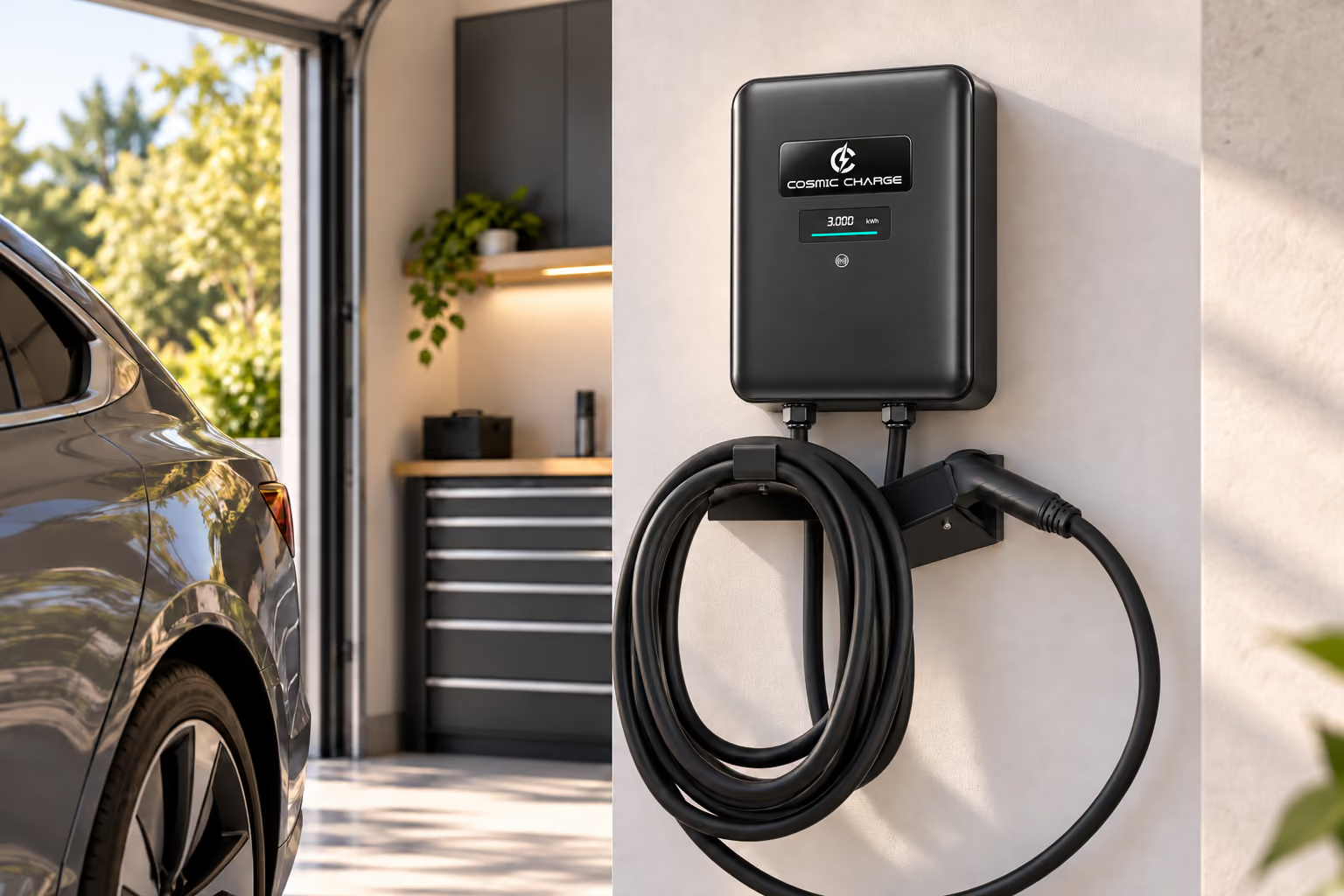
Cosmic ultra
Product Specifications

Everything you need to know about Cosmic Ultra, including key specifications, dimensions, and technical details.

Updated 10/12/26

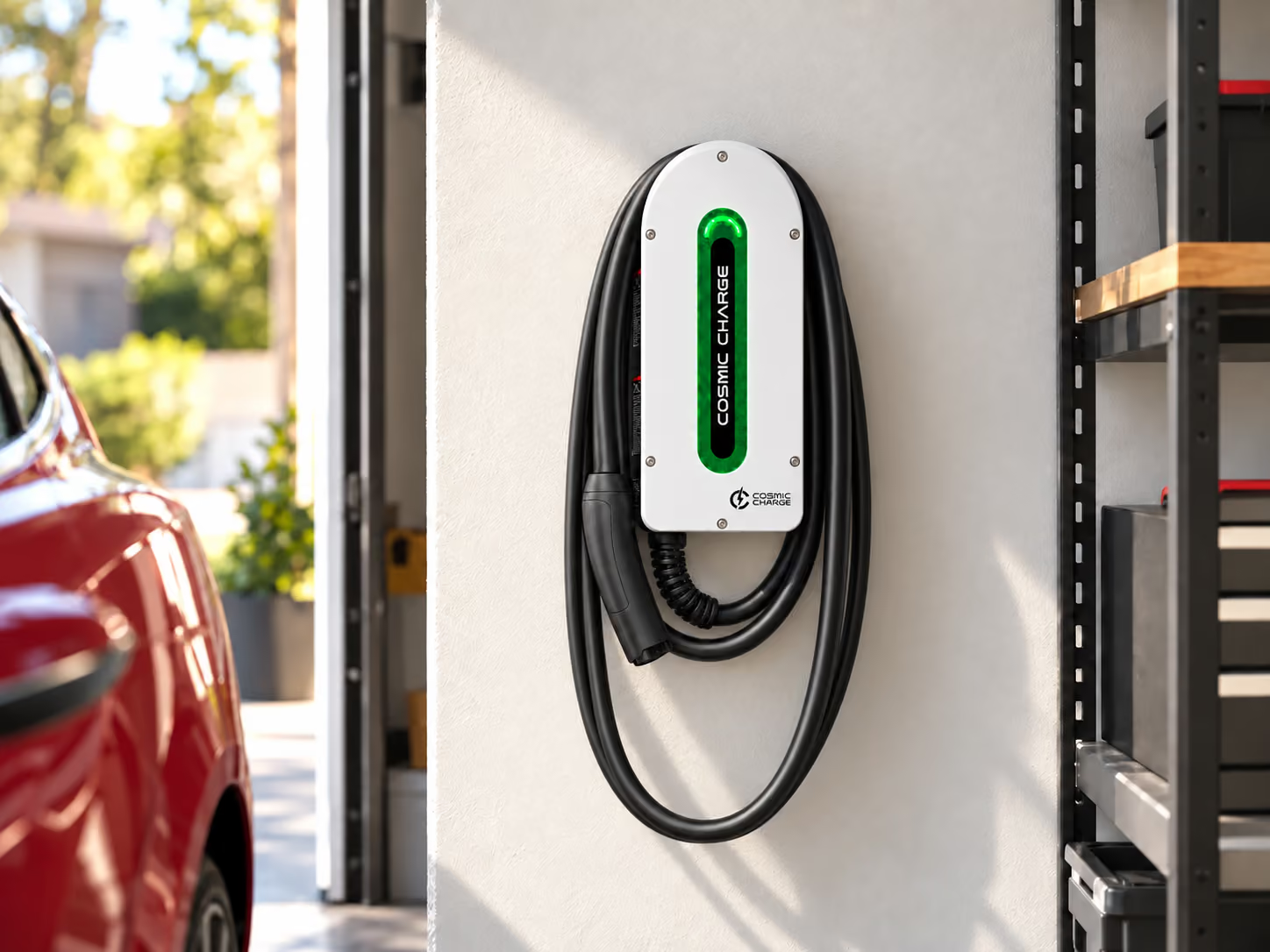
Cosmic home  
Product Specifications

Everything you need to know about Cosmic Home, including key specifications, dimensions, and technical details.

Cosmic Charge
EV Knowledge Center

Charge smarter. Drive confidently. Everything you need to know about charging your EV.

EV Range & Confidence

How far can an EV travel on a full charge?

EV range varies by vehicle, battery size, driving conditions, temperature, speed, terrain, and use of heating or air conditioning. The U.S. Department of Energy reports that today's all-electric vehicles commonly have driving ranges of approximately 150–400 miles, while individual models may fall outside that range. (Alternative Fuels Data Center)‍

‍

Cosmic Charge Tip: Your everyday charging needs are usually much smaller than a full battery recharge. Charging at home overnight can replenish the energy you use during your daily commute.

What is EV range anxiety?

Range anxiety is the concern that an EV may not have enough battery range or access to a charging station when needed.

‍

Fortunately, charging infrastructure continues to expand, while modern EVs increasingly offer longer driving ranges. The DOE notes that many EVs can travel 200–300 miles or more on a charge, helping reduce range concerns for many drivers. (Alternative Fuels Data Center)

‍

Cosmic Charge Tip: A home Level 2 charger gives you a convenient place to recharge every day, helping make your vehicle's available range more predictable.

Do I need to charge my EV to 100% every night?

Not necessarily. Your vehicle manufacturer's recommended charging settings should always take priority.

‍

For everyday driving, many EV owners can use a lower charging limit and reserve a full charge for longer trips when additional range is needed. Charging behavior can vary by battery chemistry and vehicle manufacturer, so check your owner's manual for the recommended daily charging limit.

‍

Cosmic Charge Tip: Instead of waiting for your battery to get nearly empty, think of home charging as replenishing the miles you use each day.

How does Texas heat affect EV range?

Extreme temperatures can affect EV performance and driving range. The DOE explains that extreme temperatures can reduce range because additional energy may be required to heat or cool the cabin. NHTSA also notes that EV battery thermal-management systems consume some battery energy when maintaining battery temperature. (Alternative Fuels Data Center)

‍

Cosmic Charge Tip: When practical, park in a garage or shade and use your vehicle's preconditioning features while plugged in.

How should I prepare my EV for a road trip?

Before a long trip:

  • Fully or appropriately charge your vehicle according to the manufacturer's recommendations
  • Identify compatible charging stations along your route.
  • Check the expected distance between charging stops.
  • Consider backup charging locations.
  • Account for weather, highway speeds, hills, cargo, and climate-control use

‍

The DOE recommends considering charging availability along your route and whether your vehicle can comfortably travel between charging locations. (Alternative Fuels Data Center)

‍

Cosmic Charge Tip: A little planning can turn range anxiety into range confidence.

EV Safety

Is it safe to charge my EV overnight?

Yes. Home EV charging is designed to be used routinely, including overnight, when the vehicle, charging equipment, electrical system, and installation are properly configured.

‍

The DOE reports that most EV owners charge at home overnight using Level 1 or Level 2 equipment. (Alternative Fuels Data Center)

‍

For permanent Level 2 installations, Cosmic Charge recommends professional installation in accordance with applicable electrical codes, manufacturer instructions, permitting requirements, and local AHJ requirements.

Can I charge my EV in the rain?

Yes. EV charging equipment designed and listed for outdoor use can be used in wet weather when properly installed and operated according to the manufacturer's instructions.

‍

NHTSA specifically states that plug-in EV chargers are weather-resistant, while the DOE notes that outdoor EV charging is safe when outdoor-rated equipment is used. (NHTSA)

‍

Never use damaged charging equipment or connectors.

Can I use an extension cord with my EV charger?

Do not use an extension cord unless your vehicle and charging-equipment manufacturer specifically permits it.

‍

For a permanent Level 2 installation, the safer approach is a properly designed electrical circuit installed specifically for the EV charging equipment.

‍

The DOE recommends that charging installations comply with applicable codes and regulations and be completed by an appropriately qualified electrical contractor. (Alternative Fuels Data Center)

What happens if my EV is flooded?

A flooded or severely damaged EV should be treated as a potential high-voltage hazard.

‍

NHTSA warns that flooded EVs can present high-voltage shock and fire hazards. If your EV has been exposed to significant flooding or you suspect battery damage, contact your vehicle manufacturer/dealer and emergency services when appropriate. (NHTSA)

‍

Do not attempt to charge or operate a potentially damaged high-voltage battery without professional guidance.

Who should install my Level 2 charger?

A permanent Level 2 EV charging installation should be evaluated and installed by an appropriately licensed/qualified electrical contractor familiar with EV charging equipment and local permitting requirements.

‍

The DOE states that charging-station installations must comply with applicable local and state codes and regulations and be completed by a licensed electrical contractor. (Alternative Fuels Data Center)

‍

Cosmic Charge: Our goal is to help customers select charging equipment that fits their vehicle, electrical system, and intended use.

Charging 101

What is Level 2 EV charging?

Level 2 is AC charging that typically uses 208–240 volts. It provides substantially more charging power than a standard 120-volt Level 1 outlet.

‍

The DOE identifies Level 2 as a common choice for residential, workplace, and public charging. (Alternative Fuels Data Center)

How fast is Level 2 charging?

The DOE gives a general Level 2 estimate of approximately 10–30 miles of driving range per hour of charging, depending on the vehicle and charging equipment. (Alternative Fuels Data Center)

‍

Higher-powered Level 2 equipment can provide substantially more charging power than a typical 7.2 kW installation.

‍

Cosmic Charge: Our high-performance solutions can provide up to 19.2 kW of Level 2 charging power, depending on the specific charger configuration and electrical installation.

‍

Important: Your EV's onboard AC charging system determines how much power the vehicle can actually accept.

What is the difference between NACS and J1772?

J1772 and NACS/J3400 are AC charging connector standards used by EVs and charging equipment.

‍

Cosmic Charge offers charging solutions designed for:

NACS and J1772-compatible EVs.

‍

The correct connector depends on your vehicle and the specific charger configuration.

How much power can my EV accept?

The maximum charging power isn't determined by the charger alone.

‍

Your actual charging rate depends on the lower limit of several factors, including:

EV's maximum AC charging capability + charger output + electrical installation capacity + charging conditions.

‍

For example, a 19.2 kW charger doesn't mean an EV with an 11.5 kW onboard AC charger will charge at 19.2 kW.

‍

Cosmic Charge Tip: Think of it this way - Your EV determines how much power it can accept. Your electrical system determines how much power can safely be delivered.

Do I need an electrical panel upgrade to install a Level 2 charger?

Not necessarily.

‍

Whether an upgrade is required depends on your home's existing electrical service, existing loads, charger configuration, applicable electrical codes, and the requirements of your local AHJ.

‍

Smart or managed charging technologies can sometimes adjust EV charging power to remain within an established electrical capacity. The DOE identifies managed charging as a strategy that can reduce infrastructure-upgrade requirements in appropriate applications. (The Department of Energy's Energy.gov)

‍

Cosmic Charge Tip: We believe homeowners should determine whether a smart load-management solution is appropriate before automatically assuming an expensive electrical upgrade is necessary.

How long will it take to charge my EV?

Charging time varies based on:

  • Battery size
  • Starting state of charge
  • EV's maximum AC charging rate
  • Charger power
  • Electrical configuration
  • Battery temperature
  • Charging settings

‍

For example, a vehicle capable of accepting 11.5 kW cannot charge at 19.2 kW simply because the charger is capable of producing it.

‍

Cosmic Charge: Our chargers can deliver up to 19.2kW, where supported by the vehicle and electrical installation.

Incentives & Savings

Are there EV charger incentives in Houston?

Incentives can vary by electricity provider, utility territory, location, program availability, and eligibility.

‍

For Houston-area homeowners, CenterPoint Energy Houston Electric is the transmission and distribution utility, while customers generally purchase electricity from a retail electric provider.

‍

CenterPoint currently advises Houston-area EV owners to ask their retail electricity provider about off-peak rates, including plans that may offer lower-cost charging during specified hours. (CenterPoint Energy)

‍

Cosmic Charge Tip: Don't assume a "Houston EV rebate" applies to your home. Always verify the current program, eligibility requirements, and expiration date before relying on an incentive.

Are there Fort Worth/Oncor EV charger incentives?

Potential programs and equipment discounts can change, so customers should verify current availability directly through Oncor or the applicable program administrator before purchasing equipment.

‍

For Cosmic Charge's website, I would phrase this carefully:

Fort Worth-area EV owners may be eligible for utility or program-specific EV charging incentives or equipment discounts. Eligibility depends on your address, utility service territory, equipment, and current program requirements.

‍

Don't promise a specific dollar amount unless Cosmic Charge has verified that the program is active and that your particular charger qualifies.

Are federal EV charger tax credits still available?

Not for new property placed in service after June 30,2026.

‍

The federal Alternative Fuel Vehicle Refueling Property Credit under §30C was accelerated to terminate for qualifying property placed in service after June 30, 2026. The IRS confirms that the credit is no longer available for property placed in service after that date. (IRS)

‍

For qualifying residential installations placed in service onor before June 30, 2026, the former credit could be 30% of eligible costs,up to $1,000 per item, subject to requirements including eligible-locationrules. (IRS)

‍

Cosmic Charge 2026 Notice:

Federal EV charger incentives can change as federal law changes. Please verify current eligibility with the IRS or a qualified tax professional.

How can I find current EV charging incentives?

The best starting point is the U.S. Department of Energy's Alternative Fuels Data Center (AFDC), which maintains information on EV laws and incentives.

‍

You should also check:

  • Your electric utility
  • Your retail electricity provider
  • Local government programs
  • State programs
  • Applicable federal programs
  • Your tax professional

‍

The DOE recommends using its incentives database to research available EV incentives. (Alternative Fuels Data Center)

Can my business qualify for EV charging incentives?

Potentially. Business, fleet, nonprofit, and government charging projects can have different eligibility requirements from residential installations.

‍

Federal programs, utility programs, state programs and local grants can have different rules regarding location, equipment, labor, ownership and project timing.

‍

Because incentive programs change frequently, Cosmic Charge recommends verifying eligibility before purchasing equipment or beginning construction.

Charging Best Practices

When should I charge my EV?

The best time depends on your electricity plan and driving schedule.

‍

If your electricity provider offers time-of-use or off-peak pricing, charging during lower-cost periods may reduce your charging costs.

‍

CenterPoint specifically advises Houston-area EV owners to ask their retail electric provider about off-peak rates and charging during lower-cost periods.

How can I reduce the cost of charging my EV?

Consider: 

  • Charging during off-peak hours when your electricity plan offers lower rates.
  • Scheduling charging around your departure time.
  • Using your EV or charger's smart scheduling features.
  • Avoiding unnecessary charging during expensive peak periods.
  • Monitoring your household energy consumption.

‍

DOE explains that managed charging can reduce electricity costs by shifting charging away from expensive periods and reducing coincident peak demand. (The Department of Energy's Energy.gov)

Should I charge my EV every night?

You can, but you don't necessarily need to. Your charging schedule should be based on:

  • How much you drive
  • Your vehicle's battery
  • Your daily charging limit
  • Your electricity rate
  • Your next day's driving needs

‍

For many EV owners, plugging in overnight provides enough time to replenish daily driving energy.

Should I charge my EV to 100%?

For everyday driving, follow your vehicle manufacturer's recommended charging limit.

‍

For longer trips, charging to a higher level—including 100% when recommended by the manufacturer—may be appropriate.

‍

Your vehicle's battery-management system is designed to control charging, but recommended practices vary between vehicles and battery chemistries.

‍

Always follow your vehicle manufacturer's guidance.

How can I optimize my EV charging?

A smart charging strategy can combine:

  • Vehicle needs
  • Electricity rates
  • Home electrical capacity
  • Charging schedule
  • Available renewable energy

‍

Smart charging can automatically adjust charging timing or power based on these factors. DOE describes managed charging as a way to coordinate vehicle energy needs with building and grid conditions. (The Department of Energy's Energy.gov)

Smart Charging & The Grid

What is smart EV charging?

Smart charging uses software, communication, energy monitoring, or automated controls to manage when and/or how quickly an EV charges.

The DOE describes smart charge management as technology that can adjust charging power or shift charging sessions based on factors such as vehicle needs, electricity rates, equipment capacity and building loads. (The Department of Energy's Energy.gov)

What is dynamic load management?

Dynamic load management automatically adjusts EV charging based on available electrical capacity.

‍

For example:

Home electrical demand increases

→ EV charging power decreases.

Home electrical demand decreases

→ EV charging power can increase.

‍

This helps coordinate EV charging with other electrical loads rather than allowing the EV charger to operate at maximum power regardless of what else is happening in the home.

Can smart charging prevent electrical overload?

A properly designed and configured load-management systemcan control EV charging power to remain within a defined electrical limit.

‍

However, Cosmic Charge should avoid saying that smart charging "makes an overloaded electrical system safe."

‍

The correct concept is:

Smart load management can help control EV charging demand within an established electrical capacity when the equipment, installation and applicable code requirements permit its use.

‍

The DOE recognizes managed charging as a method for enforcing power ceilings and reducing the need for infrastructure upgrades inappropriate applications. (The Department of Energy's Energy.gov)

Can smart charging reduce installation costs?

Potentially, yes.

A conventional high-power EV charger may require additional electrical infrastructure if the existing service cannot accommodate the new load.

‍

Managed charging can control EV charging power around existing building loads and may reduce or avoid certain infrastructure upgrades when the specific system is permitted and approved for the installation.

‍

DOE specifically identifies reducing charger installation costs and avoiding costly infrastructure upgrades as potential benefits of managed EV charging. (The Department of Energy's Energy.gov)

‍

Cosmic Charge Promise:

Before recommending an expensive electrical upgrade, we evaluate whether a properly designed managed-charging solution may be appropriate for your home.

Can EV charging support the electrical grid?

Yes.

Smart charging can shift charging away from periods of high demand and coordinate EV charging with grid conditions.

‍

The DOE explains that managed charging can strategically shape, shed or shift EV load while ensuring the vehicle is charged when the driver needs it. (The Department of Energy's Energy.gov)

‍

This means EVs don't necessarily have to be a burden on theelectrical system.

‍

With smart charging, they can become a more flexible electrical load.

Can EV charging work with solar energy?

Yes.

Smart charging can potentially coordinate EV charging with available solar generation, allowing a vehicle to use more locally generated electricity when conditions permit.

‍

DOE identifies maximizing local generation as one of the potential benefits of managed charging. (The Department of Energy's Energy.gov)

‍

For homeowners with solar, battery storage, and EV charging,this can become part of a broader home energy-management strategy.

need more help?

Our technical support team is ready to assist you! Please fill out the form below and we will reach out to you within 48 hours

Thank you! Your submission has been received!
Oops! Something went wrong while submitting the form.

OTHER WAYS TO REACH US

Multiple channels to get the support you need

Live Chat
Send a Text
Phone Support
281-692-3501
Email Support
Email Us